Taxation in Nigeria operates under a overhauled fiscal framework governed by the Tax Reform Acts of 2025, which took effect on January 1, 2026. This system consolidates prior fragmented legislation into four primary statutes managed by the Nigerian Revenue Service (NRS) and state boards.
Consequently, Nigeria's VAT rules also changed with the new tax laws.
VAT is one of those taxes most Nigerian business owners encounter long before they fully understand it. Oftentimes, the calculations are usually straightforward. The difficult part is knowing when VAT applies, who should collect it, what you can deduct, and when the money needs to be sent to the government.
This guide explains how VAT works, how to calculate it, the difference between input and output VAT, which transactions are zero-rated or exempt, and what your business needs to keep track of.
What is VAT?
VAT stands for Value Added Tax. It is a consumption tax charged on taxable goods and services.
In simple terms, the final cost of VAT is generally borne by the customer, while businesses in the VAT system collect and account for the tax as goods and services move through the supply chain.
Under the Nigeria Tax Act 2025, the standard VAT rate is 7.5% on taxable supplies.
Let's take a look at a simple example of how VAT is calculated. Suppose your business sells office furniture for ₦400,000 before VAT.
The calculation is shown below:
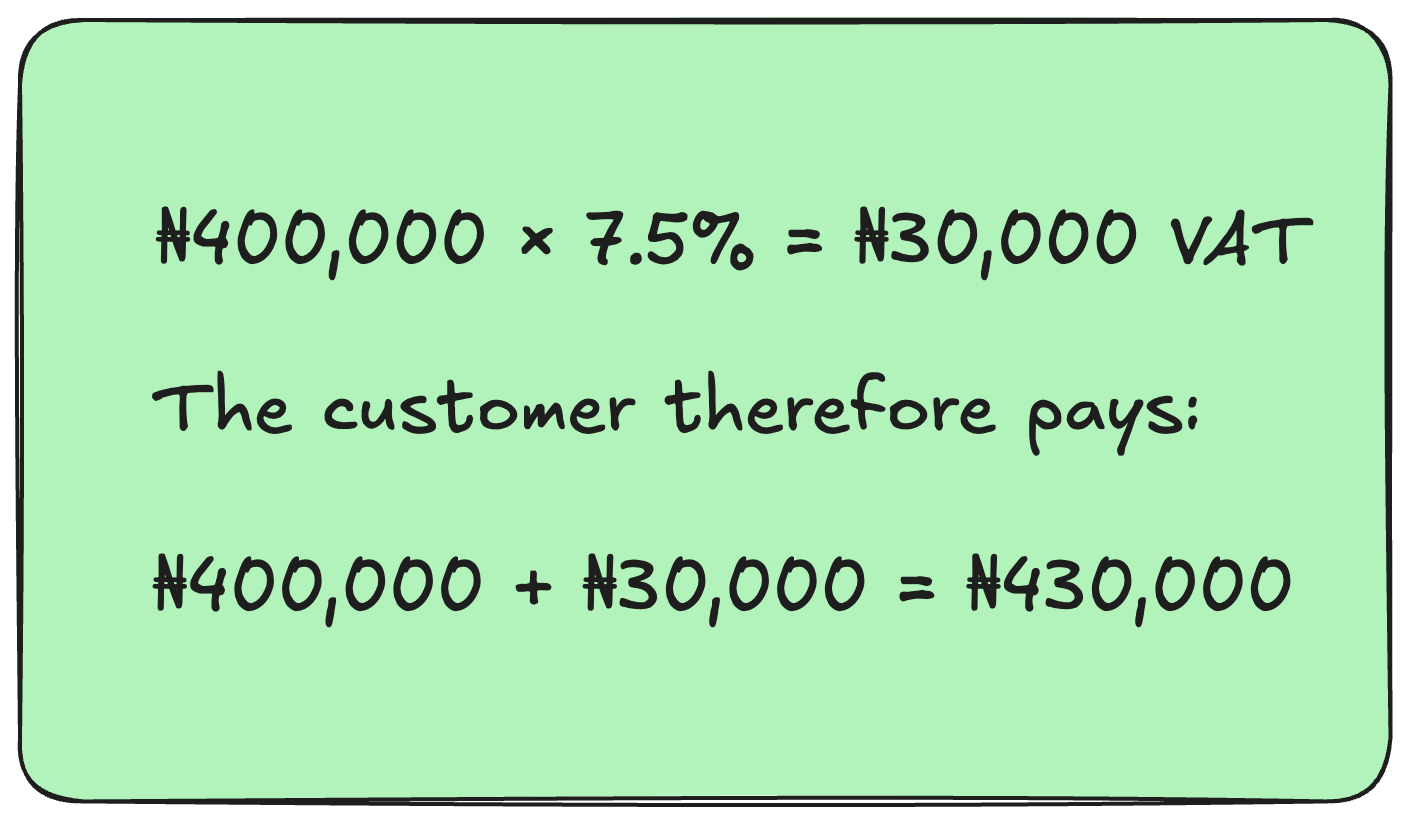
The important thing to understand is that the extra ₦30,000 is not additional sales income your business has earned. It is VAT you have collected as part of the transaction and must account for appropriately.
This distinction matters because looking at the ₦430,000 entering your bank account and treating the entire amount as revenue would overstate your actual sales.
How VAT works in practice
VAT becomes a lot easier to understand when you follow one transaction from purchase to sale.
Imagine you run a small furniture business in Lagos.
In July, you purchase taxable materials from a supplier for ₦200,000 plus VAT.
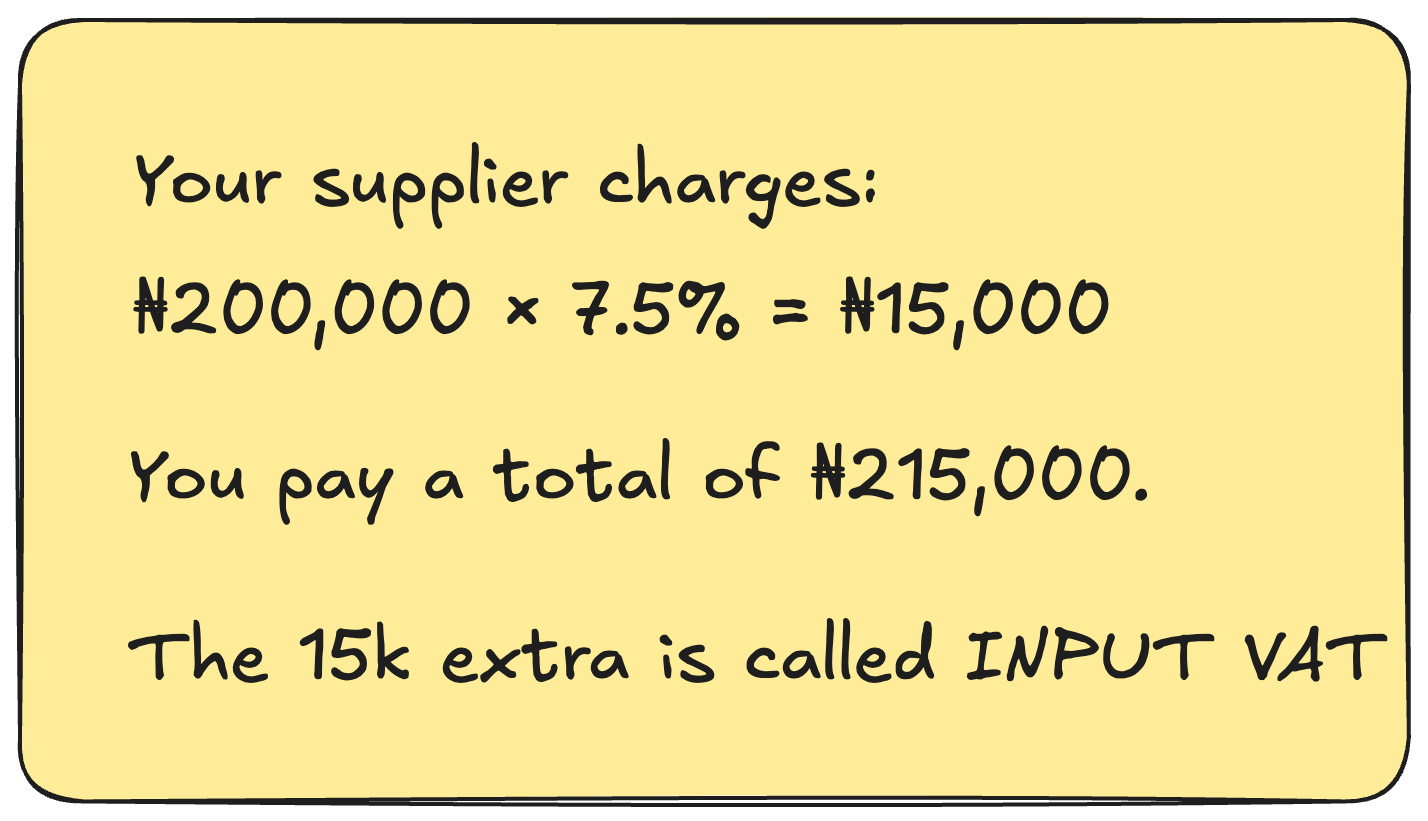
You then use those materials to produce furniture that you sell to a corporate customer for ₦500,000 before VAT.
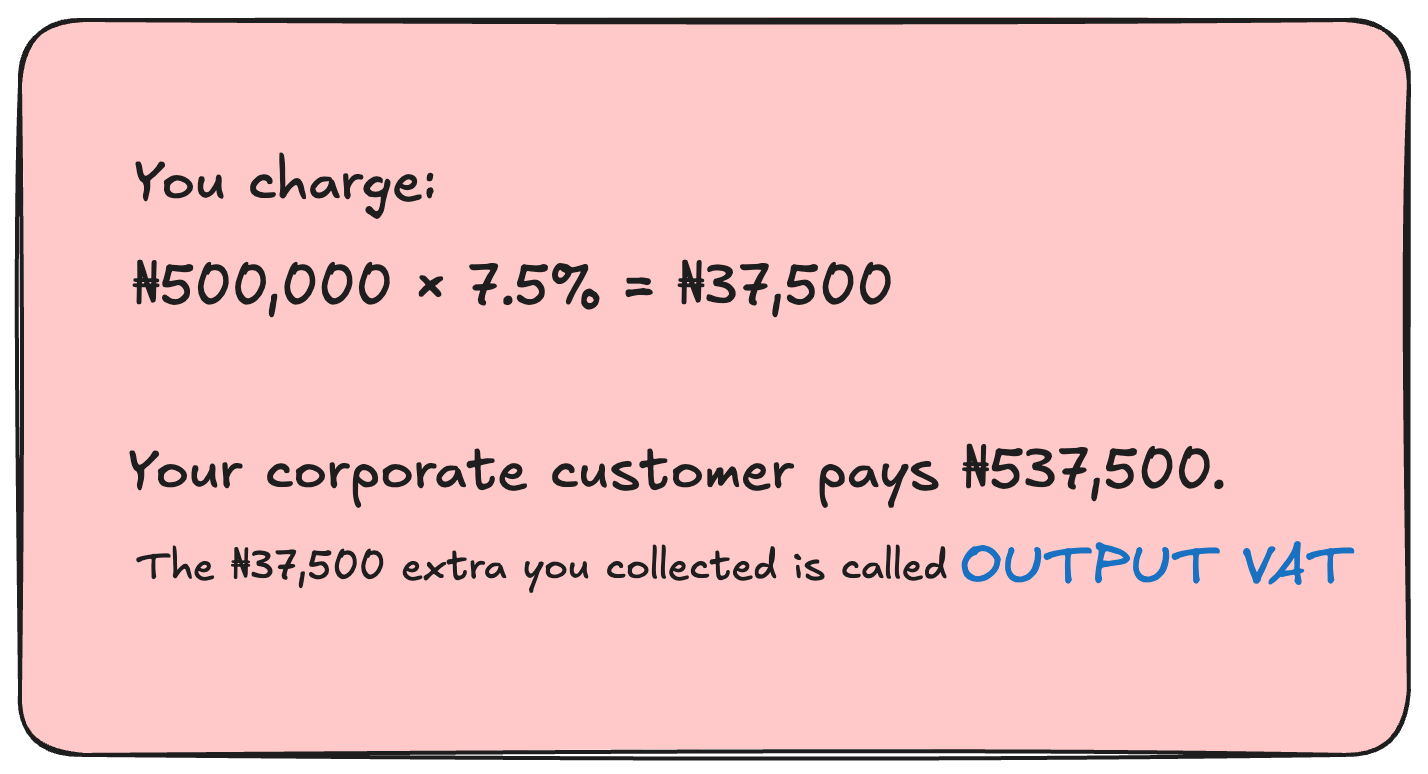
Now, there's another VAT type to understand here - VAT Payable. You don't simply send the entire ₦37,500 to the NRS. Where the input VAT qualifies for deduction, you calculate the difference:
| VAT type | What it means | Amount |
|---|---|---|
| Output VAT | VAT you collected from your customer | ₦37,500 |
| Less: Input VAT | VAT you paid on qualifying business purchases | ₦15,000 |
| VAT payable | The difference you pay to the NRS | ₦22,500 |
So your business would account for ₦22,500 as the net VAT payable for these transactions.
The Nigeria Tax Act allows qualifying input VAT incurred on taxable supplies, including services and fixed assets — to be deducted where it was incurred for the purpose of making taxable supplies. If your input VAT exceeds your output VAT, the excess can generally be carried forward as a credit, and the Act also provides a mechanism for requesting a refund.
That brings us to two terms you will see frequently when dealing with VAT.
Input VAT vs Output VAT
Output VAT
This is the VAT your business charges customers when making taxable sales.
For instance, if you provide a taxable consulting service for 1 million naira, the standard VAT would be:
₦1,000,000 × 7.5% = ₦75,000
The invoice you give to your customer would therefore total ₦1,075,000.
The ₦75,000 on it is your output VAT, that is, the tax you collect.
Input VAT
This is VAT your business pays when purchasing taxable goods or services from other people/businesses.
Suppose the same business pays ₦300,000 plus ₦22,500 VAT for qualifying services used in making its taxable supplies.
That ₦22,500 is input VAT.
If the input VAT qualifies for deduction, the business's VAT position from these two transactions would be:
| VAT calculation | Amount |
|---|---|
| Output VAT collected | ₦75,000 |
| Deductible input VAT | ₦22,500 |
| Net VAT payable | ₦52,500 |
There is an important limitation here. You cannot assume that every VAT amount appearing on every receipt is automatically deductible.
The expense must meet the requirements of the tax law. Where a cost relates partly to taxable supplies and partly to non-taxable supplies, for example, only the appropriate proportion of input VAT can be deducted.
Good records therefore matter just as much as the calculation itself.
Which goods and services attract VAT in Nigeria?
The Nigeria Tax Act divides goods and supplies into categories that include standard-rated, zero-rated and exempt supplies.
Standard-rated supplies: 7.5%
Most taxable goods and services that do not fall within a special category are subject to the standard 7.5% VAT rate.
If a taxable business sells an item for ₦100,000 before VAT:
VAT = ₦7,500
Total = ₦107,500
This is the rate you will commonly encounter on ordinary commercial transactions.
Zero-rated supplies: 0%
A zero-rated supply is still within the VAT system, but VAT is charged at 0%.
This is more important than it sounds.
Under the current law, zero-rated supplies include several essential goods and services, such as basic food items, medical and pharmaceutical products, educational books and materials, fertilisers, medical services and qualifying tuition. Exported goods, other than oil and gas, as well as exported services and exported incorporeal property are also listed as zero-rated.
Because these are zero-rated rather than simply outside the VAT system, businesses making qualifying zero-rated supplies may still have rights relating to input VAT. The Act specifically provides for refunds of VAT paid on taxable inputs used to make zero-rated supplies, subject to the applicable requirements.
VAT-exempt supplies
An exempt supply is different from a zero-rated supply.
No VAT is charged on an exempt transaction, but its treatment within the VAT system differs from a zero-rated transaction, particularly when determining whether related input VAT can be recovered.
The current Act lists several exempt supplies, including baby products, locally manufactured sanitary products, shared passenger road transport, certain agricultural equipment, land and buildings, and certain supplies for humanitarian, diplomatic and other specified purposes.
This distinction can become important if your business makes a mixture of standard-rated, zero-rated and exempt sales. In that situation, it is worth having an accountant or tax professional confirm how your input VAT should be allocated.
When should VAT be recognised?
Another common question is whether VAT becomes relevant when you send an invoice or only when your customer actually pays you.
Under the Nigeria Tax Act, the timing rule is broader than simply waiting for cash to reach your bank account.
Generally, a taxable supply is treated as taking place when an invoice or receipt is issued, goods are delivered or made available, payment becomes due, or payment is received — whichever happens first. Special rules apply to situations such as instalments and periodic supplies.
Consider a consultant who completes taxable work and issues a ₦500,000 invoice on 28 July 2026, but the customer does not pay until 15 August.
It would be risky to assume the transaction belongs to August simply because that is when the cash arrived. The VAT time-of-supply rules can cause the tax point to arise earlier.
This is one reason your VAT records should not be built from bank transactions alone. You also need invoices, bills, receipts and the dates on which supplies took place.
What information should appear on a VAT invoice?
The Nigeria Tax Act requires taxable persons making taxable supplies to maintain sequential invoice numbering and issue VAT invoices.
Among other information, a VAT invoice should contain the supplier's Tax ID, invoice number, supplier name and address, business or incorporation registration number, date of supply, customer name, gross transaction amount, VAT rate and VAT charged.
That means an invoice should make it easy to distinguish the value of the actual sale from the VAT being charged.
For example:
| Description | Amount |
|---|---|
| Website development services | ₦800,000 |
| VAT at 7.5% | ₦60,000 |
| Total invoice | ₦860,000 |
Clear invoices make life easier for you, your customer and your accountant. They also give you better documentation when preparing VAT returns or supporting input VAT claims.
Do all small businesses have to charge VAT?
Not necessarily.
The Nigeria Tax Administration Act provides an exemption from monthly VAT returns for a small business and allows an eligible small business to opt into the VAT system by written notice. Once a business ceases to qualify as small, it must begin filing monthly VAT returns.
There has been some confusion in secondary guides about the exact turnover threshold because different versions and commentary around the 2025 tax reforms circulated before implementation. The gazetted legislation published by the Nigerian Investment Promotion Commission defines a small business for these purposes as one earning ₦50 million or less in annual gross turnover, with total fixed assets below ₦250 million, while businesses providing professional services are excluded from the small-business classification.
Because threshold interpretation has been an area of conflicting public commentary, businesses close to the limit — or businesses providing professional services — should confirm their current position with the Nigeria Revenue Service or a qualified tax adviser rather than relying on an old blog post or social-media summary.
How and when do you file VAT returns?
For businesses required to file VAT returns, VAT is generally a monthly obligation.
The Nigeria Tax Administration Act requires a VAT return to be submitted to the Nigeria Revenue Service on or before the 21st day of the following month. The return reports input VAT, output VAT and the VAT payable for the preceding month.
So if your business makes taxable transactions during July 2026, the relevant VAT return would ordinarily be due by 21 August 2026.
A practical monthly process looks like this:
- Record all taxable sales for the month.
- Separate the sales value from the output VAT collected.
- Record business purchases and the VAT paid on them.
- Identify which input VAT amounts qualify for deduction.
- Calculate output VAT minus deductible input VAT.
- Prepare and submit the VAT return by the applicable deadline.
- Pay any VAT due and keep the supporting invoices and records.
Do not wait until the 20th of every month to reconstruct these numbers from your bank statement. Recording VAT correctly when transactions happen makes the eventual return much easier.
Common VAT mistakes businesses should avoid
One of the simplest mistakes is treating VAT collected as revenue.
If you invoice ₦1,000,000 plus ₦75,000 VAT, your sales revenue from that transaction is not ₦1,075,000. The ₦75,000 VAT needs to be tracked separately.
Another problem is recording only the total amount paid. If your supplier's invoice is ₦215,000 including ₦15,000 VAT, recording the entire ₦215,000 without separating the VAT makes it harder to identify potential input VAT credits later.
Businesses can also run into problems when they assume every product has the same VAT treatment. Basic food items, for example, are zero-rated under the current law, while many ordinary commercial products are standard-rated.
Finally, keep proper invoices. A bank debit showing that you paid a supplier tells you money left the account, but it does not necessarily contain all the information needed to support the VAT treatment of the transaction.
What should your business do next?
You don't need to become a tax expert to manage VAT well. But you do need a reliable process.
Start by confirming whether your business is required to participate in the VAT system and whether the goods or services you sell are standard-rated, zero-rated or exempt.
Then make sure your invoices show VAT clearly where applicable. Record output VAT separately from sales income and input VAT separately from the underlying business expense.
Most importantly, keep your bookkeeping current. VAT becomes unnecessarily difficult when you have to search through months of bank alerts, receipts, WhatsApp messages and supplier invoices just before a filing deadline.
If your business operates across several VAT categories, imports goods, buys services from foreign suppliers, exports services, has recently crossed the small-business threshold or is unsure whether an input VAT claim is allowed, speak with a qualified accountant or tax professional.
The main thing to remember about VAT
VAT is easier to manage when you stop thinking of it as an occasional tax calculation and start treating it as part of your everyday bookkeeping.
For a business within the VAT system, every taxable sale can create output VAT, while qualifying purchases can create input VAT. Keeping those amounts separate gives you a clearer picture of what belongs to the business and what may ultimately be payable to the Nigeria Revenue Service.
This is also where consistent accounting records make a practical difference. Bukki can help you record and categorise transactions, track VAT on sales and expenses, reconcile invoices and payments, and keep the information your accountant needs in one place.
The goal is not simply to calculate 7.5% correctly. It is to have records that let you understand where the number came from, support it with the right documents and deal with VAT as a normal part of running your business.
This article is for general educational purposes and does not constitute tax, accounting or legal advice. Nigerian tax rules can change, and the correct treatment can depend on the nature of your business and transactions. For decisions affecting your tax position, check current guidance from the Nigeria Revenue Service or speak with a qualified tax professional.
Recommended articles
The Bukki Team · Jul 21, 2026
How to File Your Tax Returns With the NRS as an Individual or Business
The Nigeria Revenue Service now uses Rev360 for tax filing. Learn how to get your Tax ID, log in, and file your taxes without the confusion.
The Bukki Team · Jun 26, 2026
How to Prepare for NRS Taxes: A Practical Guide for Nigerian SMEs
Learn how Nigerian small businesses can prepare for VAT, WHT, company income tax, PAYE records, and tax filing without waiting until the deadline.

The Bukki Team · Sep 29, 2026
Top 11 Programmes That Can Fund Your Business or Startup for Free
This post explores the top 11 funding programmes offering free grants and capital to launch or scale your business in Nigeria without giving up equity.